


Core Value Statement
"A Commitment to Excellence in Knowledge Generation to Achieve Sustainability"
The Roots and Growth
CCD Gujarat, founded in 2002 in Vadodara, is a Jesuit-inspired research centre focused on society, culture, and development. Its mission is to serve Gujarat’s marginalized communities through socially relevant research and knowledge sharing.The Roots and Growth
CCD Gujarat, founded in 2002 in Vadodara, is a Jesuit-inspired research centre focused on society, culture, and development. Its mission is to serve Gujarat’s marginalized communities through socially relevant research and knowledge sharing.Vision
CCD is an academic organization meant to harness the knowledge of social sciences to the service of Gujarat society, specifically its disadvantaged sections the minorities, tribals, Dalits and women.Vision
CCD is an academic organization meant to harness the knowledge of social sciences to the service of Gujarat society, specifically its disadvantaged sections the minorities, tribals, Dalits and women.Mission
CCD endeavours to provide a range of relevant and reliable researched data, primarily on religion, society, culture and development in Gujarat towards building a humane and just society.Mission
CCD endeavours to provide a range of relevant and reliable researched data, primarily on religion, society, culture and development in Gujarat towards building a humane and just society.The Roots and Growth
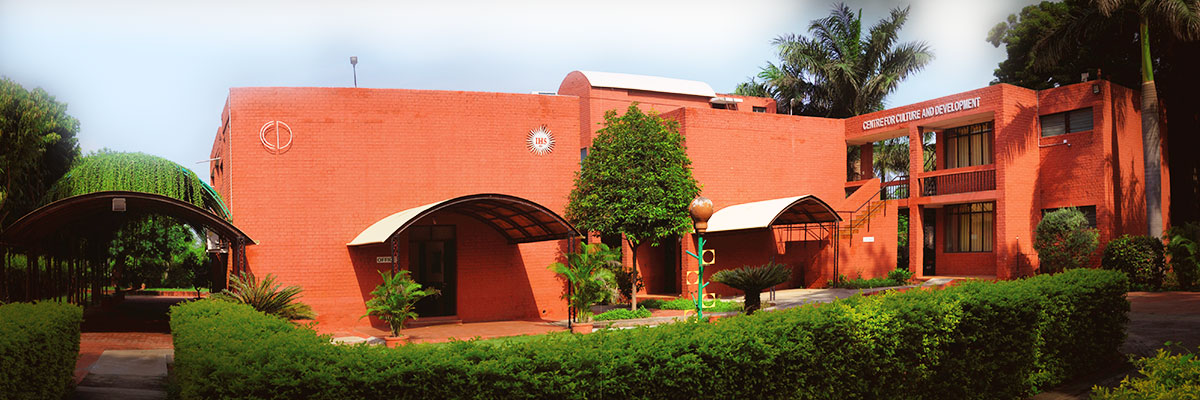
The Centre for Culture and Development (CCD) was established in 2002, when several forces were unleashed worldwide and in India, not necessarily enhancing human development and social inclusion. Millennium globalisation and varied sets of fundamentalism were among them. The CCD is a Jesuit-inspired centre of higher education and research located in Vadodara. The reason Vadodara was chosen was that it was the seat of the renowned Maharaja Sayajirao University of Baroda; the ‘sanklap’ (vow) of Dr. Bhim Rao Ambedkar; and the city lacked social research institutes, unlike Ahmedabad and Surat. The CCD was initiated by Lancy Lobo SJ, who worked for 15 years at the Centre for Social Studies (CSS), Surat. He was the first director of CCD, with some very competent and committed scholars such as the late A. M. Shah and Juzar S Bandukwala, on the Board of Trustees. The founders of CCD wanted it to be a social research institution that could evaluate the society, culture, and development taking place within it.
Contributing through intellectual work to the creation of a just and humane society is integral to the works of the Jesuits. Jesuits are, thus, expected to be engaged in the field of learning, intellectual work, and work in varied areas of society with different people while bringing an analytical mindset to all their endeavours (“The Intellectual Apostolate in the Society’s Mission", Pedro Arrupe, Superior General, 1976). They are expected to bring academic reflection and the concrete life of people together. Therefore, Jesuit commitment to intellectual endeavour must be free of every desire for personal advancement and of a spirit of competition and rivalry, because this commitment is inspired by a desire to serve (Letter of Adolfo Nicolás, S.J. Superior General, ‘On Jesuits missioned to the intellectual apostolate', dated on 24 May 2014).
CCD as an institution of research and higher learning, has completed more than two decades. Its overarching goal is to carry out research, disseminate the findings and contribute concretely to knowledge building with the underpinning of social sciences on issues of socio-cultural, economic and political significance, with particular reference to Gujarat. It is an academic institution engaged in learning and harnessing knowledge of social sciences in the service of Gujarati society, particularly its marginalised and disadvantaged populations and, more specifically, minorities, Adivasis, Dalits, and women across communities.
The reasons for CCD's existence and its statement of purpose, as it continues to serve the people of Gujarat, particularly those on the margins, through knowledge generation and dissemination based on social sciences under the leadership of James Regina C. Dabhi, SJ, the current director, and the team, are as follows:
- Research, knowledge building, learning and sharing are key elements of its establishment.
- The subject matter of the Centre’s research will be relevant and anchored in social sciences.
- The findings of the research and knowledge generated from research studies, seminars and workshops are disseminated through publications in academic circles. The findings and knowledge thus generated are to be shared with stakeholders, policymakers and practitioners.
- The research and studies are contextual and relevant to the lived realities of people of Gujarat and the country. Therefore, the choice of what we take up for research in some way reflects personal and collective perspective, analysis of reality and practical approach.
- CCD is not an institution of implementation, but through our research and knowledge generation, we do make academic/intellectual interventions in society. The beneficiaries are academia, policymakers, civil society organisations and development agencies.